


 Contact Us


Key points of this article
- Hoses should be tightened at a position above the indentation between the barbs in the center of the hose nipple.
- It may be necessary to install two hose clamps when the inner diameter is large or operating pressure is high.
- When using two hose clamps, they should be positioned in an offset pattern.
- They should not be overtightened or too loose, and a torque wrench should be used to maintain consistent tightening force.
Properly Installing Hose Clamps to Prevent Leaks and Disconnections
There are four main points to note for ensuring safe and secure installation of hose clamps in order to prevent leaks and disconnections.
①Hose clamp tightening position
②Hose clamp quantity
③Hose clamp orientation
④Hose clamp tightening force
Now, before explaining each key point, here’s a question from Hose Adviser PRO.

What is the ideal position for installing the hose clamp when inserting the hose into the nipple and tightening it with a hose clamp?
Select from among A, B and C below.


The correct answer is B. It should be installed in the center.
Let’s see why B is the ideal position.
1. Hose clamp tightening position
The installation position of the hose clamp is important for preventing fluid leaks and hose disconnections.
The hose clamp should be installed on the hose nipple (Fig. 1) so that it presses down on the indentation between the barbs (Fig. 2).
(Fig.2)Install the clamp so that it presses down on the indentation between the barbs.
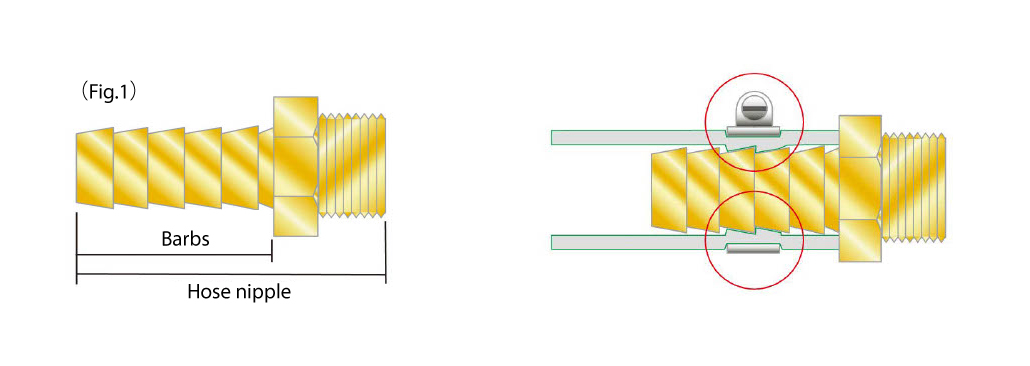
This will ensure the barbs bit into the hose, reducing the risk of the hose becoming disconnected or leaking fluid.
Here’s a video showing the correct installation position for the hose clamp.
Click the link below to watch.
【the hose clamp】Hose clamp tightening position(If the inner diameter of the hose is under 25 mm)
2. Hose clamp quantity
We recommend installing two hose clamps for Toyox soft PVC hoses with an inner diameter of 25 mm or more, or when used under high operating pressure. Using two hose clamps reduces the risk of fluids leaking or the hose becoming disconnected.
⌀25 or more

Here’s a video showing how to install a hose clamp on a hose with an inner diameter of 25 mm or more.
Click the link below to watch.
【the hose clamp】Hose clamp tightening position(If the inner diameter of the hose is 25 or more)
3. Hose clamp orientation
If two hose clamps are installed with the housing in the same orientation, a gap may form as the hose clamp is fully tightened. (Fig. 3)
We recommend tightening the hose clamps in an offset pattern to minimize gaps and prevent fluid leaks and hose disconnections.
(Fig. 3)Housing orientation when tightening with two hose clamps

4. Hose clamp tightening force
Overtightening hose clamps can damage the outside or inside of the hose, possibly resulting in fluid leaking. Likewise, undertightening can also lead to fluid leaking or the hose becoming disconnected. We recommend using a torque wrench to maintain a consistent tightening force.
For those worried about torque control and retightening, we recommend using Toyox’s TOYOCONNECTOR hose couplings, which eliminate the need for such maintenance.
TOYOCONNECTOR hose couplings not only standardize work processes but also offer numerous benefits, such as reduced time spent on piping work and significant energy-saving effects. For more details, please click on the image below to view product information on a special website.

[TOYOCONNECTOR: Zero leaks and disconnections]
Offering many benefits other than leak and disconnection prevention!
■ Click below to see video showing how TOYOCONNECTOR prevents leaks and disconnections
【Prevents leaks and disconnections】Comparison of pressure resistance safety【TOYOCONNECTOR(TC3-B)】
■ Click below to see a video showing how TOYOCONNECTOR compares with other couplings in terms of reduced work times and standardization
Comparison of installation workability|TOYOCONEECTOR VS Ordinary connector
■ Click below to see how TOYOCONNECTOR compares with barb fittings in terms of energy savings, such as changes in energy consumption
[Energy Savings] TOYOCONNECTOR vs. Barb Fittings - Could the fittings change energy usage?
That wraps up our explanation on installing hose clamps when piping hoses.
For any other inquiries or consultations, please contact the TOYOX Customer Service Office.
When using hose clamps, keeping a few key points in mind can reduce the chances of leaks and disconnections. Hose Adviser PRO provides explanations on the causes of fluid leaks and hose disconnections, as well as on installing hose clamps in a manner that prevents problems from occurring.