


 Contact Us


Key points of this article
- Highly viscous or adhesive fluids remaining inside a hose can cause various issues, including contamination.
- Using fluorine resin hoses with excellent water repellency and non-adhesive properties can help reduce residue buildup while improving cleaning efficiency.
- Using dedicated couplings provided by the hose manufacturer can reduce unevenness at connection points between couplings and hoses, preventing residue buildup while minimizing energy loss.
Why does residue build up in hoses and what are some effective methods of preventing it?
Highly viscous or adhesive fluids can often remain inside hoses, and if allowed to build up, can lead to contamination or quality degradation if mixed with raw materials. Furthermore, residue can lead to issues including odor and discoloration due to reasons such as microbial growth. Some fluids may stick to the inside of the hose and harden, further increasing the risk of contamination.
Now, here’s a question for everyone from Hose Adviser PRO.

What is the most effective method of reducing residue that causes all kinds of issues?
A. Replace hoses with every use
B. Use hoses with excellent water repellency and non-adhesive properties
C. Use high-pressure cleaning to wash away fluids

The correct answer is B. Use hoses with excellent water repellency and non-adhesive properties.
Although many worksites may use high-pressure cleaning to wash away fluids as mentioned in C., this method requires significant time, cost, and energy consumption. As a result, some worksites use dedicated hoses for each raw material, replacing or disposing of them as needed.
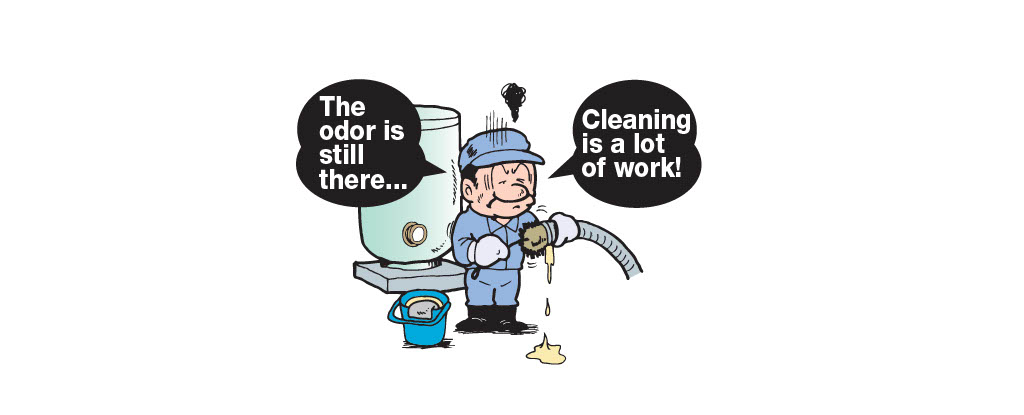
The most effective method for reducing fluid residue and reducing cleaning times is to use hoses made from materials with excellent water repellency and non-adhesive properties. Hoses with excellent water repellency and non-adhesive properties prevent fluids from adhering to the hose inner surface, significantly reducing residue buildup while lowering the risk of contamination. Such hoses enable debris and residue to come off easily during cleaning, allowing the inside of hoses to be cleaned with less water and cleaning solution, reducing both cleaning time and the usage of cleaning solutions. Because residue is minimized, the same hose can be used for other fluids while presenting a lower risk of contamination or of mixing with raw materials.
What hose materials have excellent water repellency and non-adhesive properties?
Hoses made from fluorine resin are a good example of hoses with excellent water repellency and non-adhesive properties. For example, fluorine hoses with an inner surface made of tetrafluororesin (modified ETFE) have a water repellent angle of 96°, as well as excellent water repellency and non-adhesive properties. Thanks to their excellent chemical and solvent resistance, as well as low elution, these hoses are commonly used for conveying and transporting chemicals, pharmaceuticals, pure water, cosmetics, food, and semiconductors.

Fluorine Hose Series
For those seeking hoses with excellent water repellency and non-adhesive properties
Additionally, using dedicated couplings provided by the hose manufacturer can reduce unevenness at connection points, minimizing residue buildup at couplings. This helps prevent issues such as contamination caused by residue buildup.
Using hoses with excellent water repellency and non-adhesive properties also improves fluid flow, reducing pressure loss while minimizing energy loss.

[TOYOCONNECTOR: Zero leaks and disconnections]
Offering many benefits other than leak and disconnection prevention!
■ Click below to see video showing how TOYOCONNECTOR prevents leaks and disconnections
【Prevents leaks and disconnections】Comparison of pressure resistance safety【TOYOCONNECTOR(TC3-B)】
■ Click below to see a video showing how TOYOCONNECTOR compares with other couplings in terms of reduced work times and standardization
Comparison of installation workability|TOYOCONEECTOR VS Ordinary connector
■ Click below to see how TOYOCONNECTOR compares with barb fittings in terms of energy savings, such as changes in energy consumption
[Energy Savings] TOYOCONNECTOR vs. Barb Fittings - Could the fittings change energy usage?
That wraps up our explanation on methods of preventing hose contamination by eliminating residue.
For any other inquiries or consultations, please contact the TOYOX Customer Service Office.
When hoses are used to carry highly viscous or adhesive fluids that may not be completely drained from the hose, residual fluid can build up inside the hose and increase the risk of contamination. In this article, Hose Adviser PRO will introduce tips for eliminating residue from inside hoses and preventing contamination.