


 Contact Us


Key points of this article
- There are four main causes of hose bending and collapsing:
1. Bending the hose beyond its minimum bending radius
2. Heat-induced softening
3. Inability of the hose to support its own weight with fluid inside
4. Using a non-suction hose for a suction application - The best way to prevent these kinds of problems is to select a hose that is resistant to bending and collapsing and specifically designed for the intended application.
Four causes of hose bending and collapsing
1, Bending the hose beyond its minimum bending radius
2, Heat-induced softening
3, Inability of the hose to support its own weight with fluid inside
4, Using a pressure-feed braided hose for a suction application
To learn more about each of these four causes, register on the TOYOX website to download detailed technical resources.
[Recommended resources] * Registration required to download
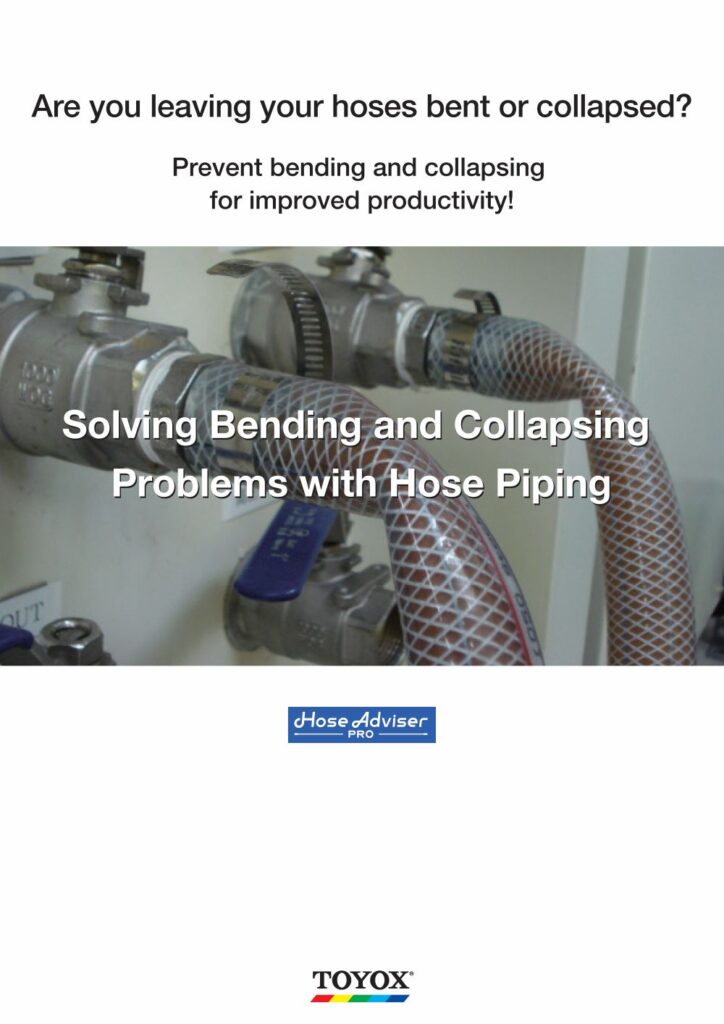
Solving Bending and Collapsing Problems in Hose Piping
Learn more about the causes of bending and collapsing

Tips for Installing Hoses in Tight Spaces
Get help installing hose piping problems in tight spaces
Register on the TOYOX website to access over 70 resources on hose and coupling troubleshooting and useful tips.
Click the link below to register as a member.
Two countermeasures to prevent hose bending and collapsing
There are two main ways to prevent hose bending and collapsing caused by the four factors above.
But first, here’s a quick question for everyone from Hose Adviser PRO.

Which of the following is not a suitable method to prevent hose bending?
Select from among A, B, and C below.
A. Select a hose that is resistant to bending and collapsing.Select a hose that is resistant to bending and collapsing.
B. Select the right hose for the application.
C. Replace the hose every month.

The correct answer is C. Replace the hose every month.
Hose replacement timing varies depending on the type of hose and the conditions of use, so there is no general rule for replacing the hose every month.
Both A and B are suitable methods to prevent hose bending and collapsing.
The methods are explained in order below.
1.Select the right hose for the application.
The conditions of use span a wide range and include the type and temperature of the fluid carried by the hose, as well as the pressure (positive and negative pressure). When the hose is not suitable for the conditions of use, the hose may soften or deteriorate rapidly, making bending and collapsing more likely. When the hose is used for suction, hose collapse should be prevented by using a hose that is designed to withstand suction, and which includes shape retention using a metal or resin coil.
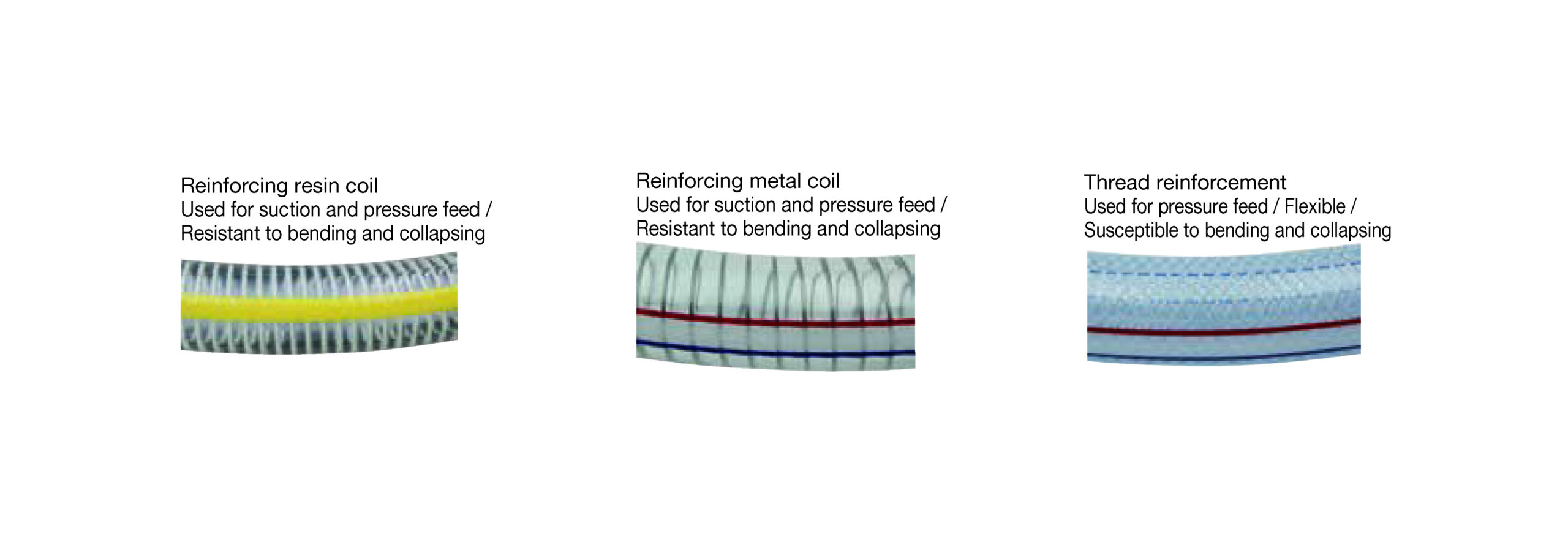
2. Select a hose that is resistant to bending and collapsing.
Hoses that are resistant to bending and collapsing include shape-retaining types that are reinforced by a metal or resin coil, as well as braided types (not suitable for suction applications) that are resistant to bending and collapsing while retaining flexibility and pressure resistance. These kinds of hoses can be used with tight bends in narrow locations such as inside equipment or in narrow equipment piping spaces.
TOYOX offers a variety of hoses that retain their shape to help prevent bending and collapsing. Check the product list below to see the best hose for specific usage conditions.

Bending and collapse prevention hoses
Shape-retaining hoses resistant to bending and collapsing
Some braided hoses are also less prone to bending and collapsing than others due to the braiding method of the reinforcement thread or the thread material used. Such models are ideal for use in tight spaces.
[Industrial applications]

HYBRID TOYORON Hose
Excellent shape retention for tight installation spaces
[Food-safe applications]

HYBRID TOYOFOODS Hose
Easier to handle and more resistant to bending and collapsing than TOYOFOODS Hoses
That wraps up our explanation on the causes and solutions of hose bending and collapsing.
For any other inquiries or consultations, please contact the TOYOX Customer Service Office.
Hose bending and collapsing can reduce or block the flow of fluid, resulting in reduced productivity and unexpected accidents.
To prevent such problems from arising, it is important to take proper steps to prevent hoses from bending or collapsing. In this article, Hose Adviser PRO will explain the causes of hose bending and collapsing, and how to effectively prevent them.